Land of Management Team
Aug 17

How to Study for the PMP Exam in 2026: A Practical Plan

Key Takeaways

  • Your 2026 PMP prep should start with confirming eligibility, choosing exam content sources, and setting a realistic weekly schedule

  • A structured routine of concept learning, practice questions, and full mock exams is the fastest path to readiness

  • You will be able to build a 6–10 week study plan, track progress, and avoid common PMP prep mistakes

You are busy, the PMP is broad, and 2026 expectations are clear

You open a PMP prep book to “get started” and immediately hit a wall: agile, hybrid, predictive, process groups, artifacts, formulas, and pages of terms you have not used in months. With a full-time job and life outside work, the hardest part is not motivation, it’s deciding what to study first so your hours actually move your score.

Most candidates need about 120–200 focused study hours to be ready. That range matters: if you spread 150 hours across 16 weeks, it feels light but easy to forget; if you cram 150 hours into 5 weeks, it’s intense and burnout is common. Works best when you can protect 5–8 hours per week; fails when you “just study when you have time” and only do random reading.

If you do one thing first, do this: turn scope into a plan you can follow weekly. For example, if you can only study 6 hours a week, a realistic target is 8–10 weeks with 3 sessions of 60–90 minutes plus one longer weekend block. If you can do 10 hours a week, 6–8 weeks can work, but only if you prioritize practice questions early rather than saving them for the end.

Common mistake: treating the PMP like a memorization project (flashcards, definitions, formulas) and delaying scenario practice. Fix it by building a checklist that forces balance every week:

  • 60–90 minutes learning or review (one domain-sized topic)

  • 45–60 minutes scenario questions (20-40 questions)

  • 20 minutes error log (why you missed it, what to watch for)

  • 10 minutes quick refresh (terms, formulas, key outputs)

If you’re short on time, skip long note-taking and do two things instead: targeted reading for weak areas and timed questions. By the end of the next sections, you’ll have a week-by-week plan and a simple checklist so you always know what to do next, even when your week gets messy.

Confirm what the 2026 PMP exam will test and what you need to apply

Next, get clear on two things before you sink hours into studying: what the exam actually tests, and whether you can apply without last-minute scrambling. A lot of candidates lose weeks reading cover-to-cover, then realize they did not match their reading to the exam’s real emphasis or they are missing application details they should have tracked from day one.

At a high level, the PMP exam is organized around three domains: People, Process, and Business Environment. In daily study, treat these as three buckets you practice every week, not three chapters you read once:

  • People: leading a team, handling conflict, working with stakeholders, supporting performance

  • Process: planning, estimating, schedules, risk, quality, procurement, and how work flows from idea to delivery

  • Business Environment: aligning work to business goals, compliance, benefits, and how decisions change when priorities shift

If you do one thing here, make a simple tracker (spreadsheet or notes) where every practice question you miss is tagged People, Process, or Business Environment. This is the fastest way to see where your study time is paying off versus where you are rereading without improving results.

So, confirm the application basics early and keep a running file of anything you will need to write down later. The application is not only about having experience, but it is also about describing it clearly (what you did, who you worked with, and what outcomes you owned) in a way that matches project work.

A practical checklist to prepare in 30 to 60 minutes:

  • Your project roles and dates for the last several years (month and year is usually enough to start)

  • 3 to 6 project summaries written in plain language (what was the goal, what you did, what changed)

  • Contact details for people who can confirm your work if needed

  • Proof of your project management education hours if you already have them

Here’s the catch: your references matter, but too many sources can slow you down. Works best when you choose a small set and reuse it for notes and review. It fails when you collect five books, three apps, and two courses and never finish a full pass.

Pick your primary references and stick to them:

  • PMBOK Guide for terminology and core concepts

  • Agile Practice Guide for adaptive ways of working you will see in scenarios

  • One main course or one main exam prep book as your day-to-day driver

If you’re short on time, skip deep reading and do this instead: follow your main course or book, then use the PMBOK Guide and Agile Practice Guide only to clarify terms you keep missing during question review.

Build a 6–10 week study plan that fits your schedule

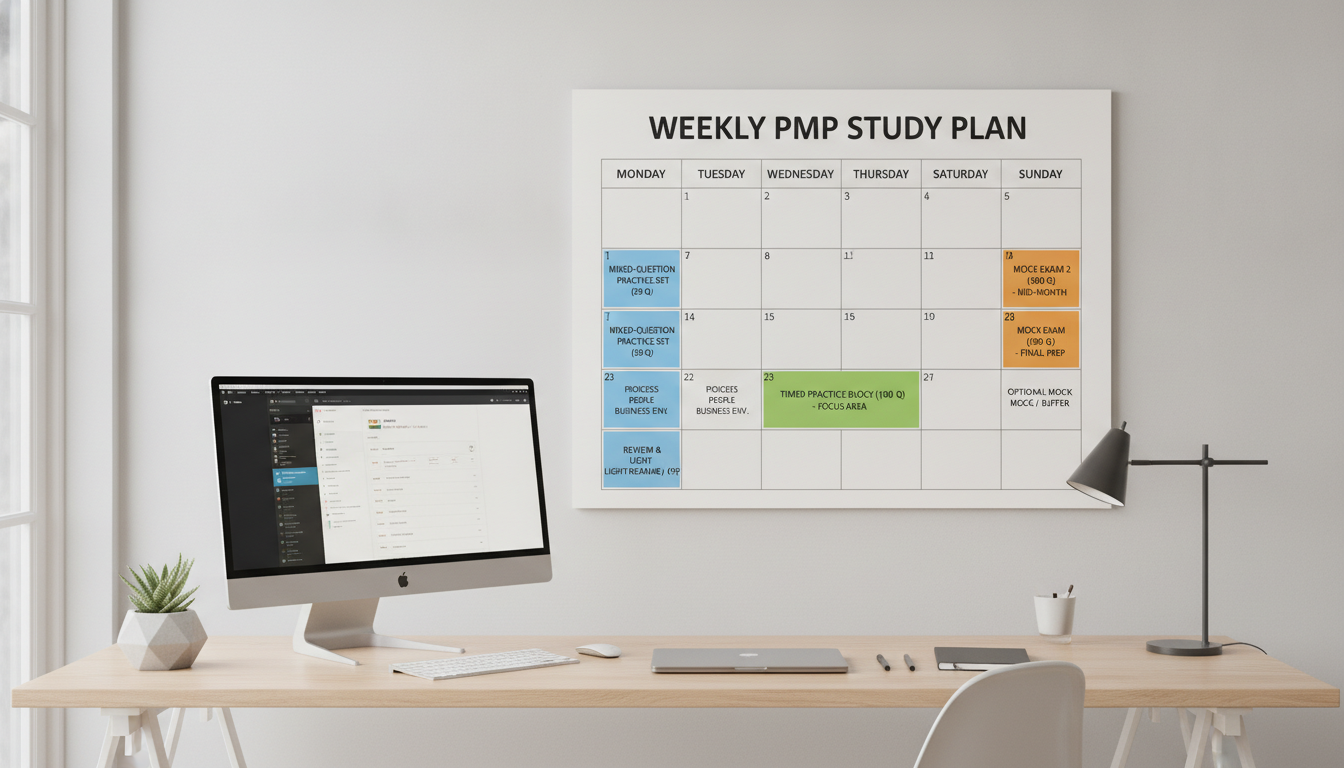
Next, stop guessing how long prep will take and pick a timeline based on the hours you can protect each week. A workable benchmark for many busy adults is 6 to 12 hours per week, split into short weekday sessions plus one longer weekend block. By the end of this section, you’ll have a repeatable weekly sprint you can run for 6 to 10 weeks without burning out.

If you do one thing, do this: schedule your hours first, then assign content second. When the calendar is real, your plan becomes realistic instead of optimistic.

So choose your timeline using your weekly hours, then map topics into weekly sprints:

  • 10 weeks: 6 to 8 hours/week (steady pace, better if work travel or family load is unpredictable)

  • 8 weeks: 8 to 10 hours/week (balanced pace for most full-time roles)

  • 6 weeks: 10 to 12+ hours/week (fast pace, works best with fewer meetings and consistent weekends)

Works best when your week is fairly repeatable; fails when your time swings wildly. If your schedule changes every week, plan in 2-week blocks and re-check every other Sunday.

That said, keep each week in the same sprint pattern so you always know what to do next. Here’s a simple weekly sprint you can repeat (example: 8 hours/week):

  1. Learn (2 hours): read or watch one topic area, take simple notes

  2. Recall (2 hours): do 30 to 50 practice questions on that topic

  3. Fix gaps (2 hours): review wrong answers and redo similar questions

  4. Mixed set (1 hour): 15 to 25 mixed questions from past topics

  5. Weekly review (1 hour): update your error log, refresh flashcards, set next week’s targets

Common mistake: spending the whole week re-reading content. Fix it by making at least half of your time active work (questions, recall, reviews), even in week 1.

In practice, your study system matters as much as the hours. Set up these four pieces on day one:

  • Notes method: one page per topic, written as prompts ("When would I use X?", "What’s the tradeoff?")

  • Flashcards: 10 to 20 per week for terms, formulas, and "confusing twins" (similar concepts you mix up)

  • Error log: a simple table with columns for question type, why you missed it, and the new rule you’ll follow

  • Weekly review loop: every 7 days, choose 3 weaknesses and plan next week’s question sets around them

If you’re short on time, skip long notes and do error log + flashcards + 30 questions. You’ll still build the memory and pattern recognition you need for exam-style questions.

Practice like it’s exam day: questions, mocks, and targeted review

Next, stop treating practice questions as a confidence check and start using them as training.

A simple cadence works well for most learners: daily mixed sets (20–40 questions), weekly timed blocks (60–120 minutes), then 2–3 full mock exams in the final stretch. Mixed sets build retrieval across domains; timed blocks build pacing; mocks test focus, endurance, and decision-making under pressure.

If you do one thing, make at least one session per week timed and interruption-free, with the same start time, calculator rules, and break plan you will use on exam day

So when you review results, diagnose gaps in two ways at once:

  • By domain (where you are consistently missing points)

  • By task type (what you are failing to do, like stakeholder conflict, change control, risk responses, or interpreting a chart)

Turn every wrong answer into a short “fix list” you can re-drill in 15–25 minute micro-sessions. For each item, write: what you chose, why it was tempting, the rule or concept you missed, and one cue you will look for next time.

Here’s the catch: doing more new questions can fail if you never close the loop. If you are short on time, skip extra question banks and spend that time re-drilling your fix list until those misses stop repeating

Closing remarks

Also, treat your PMP prep like a small project: “What gets measured gets managed.” If you track your study hours, quiz scores, and repeat weak areas each week, you will spot problems early and fix them before they become a last-minute scramble.

Next, pick one change you can make this week to study more consistently, and write it down as a simple commitment:

  • Time: Block 30 to 60 minutes on 4 weekdays, plus one longer session on the weekend

  • Materials: Cut down to one primary guide plus one question bank so you stop switching sources

  • Practice strategy: Do two timed sets (for example, 33 questions in 60 minutes) and review every missed question the same day

Created with